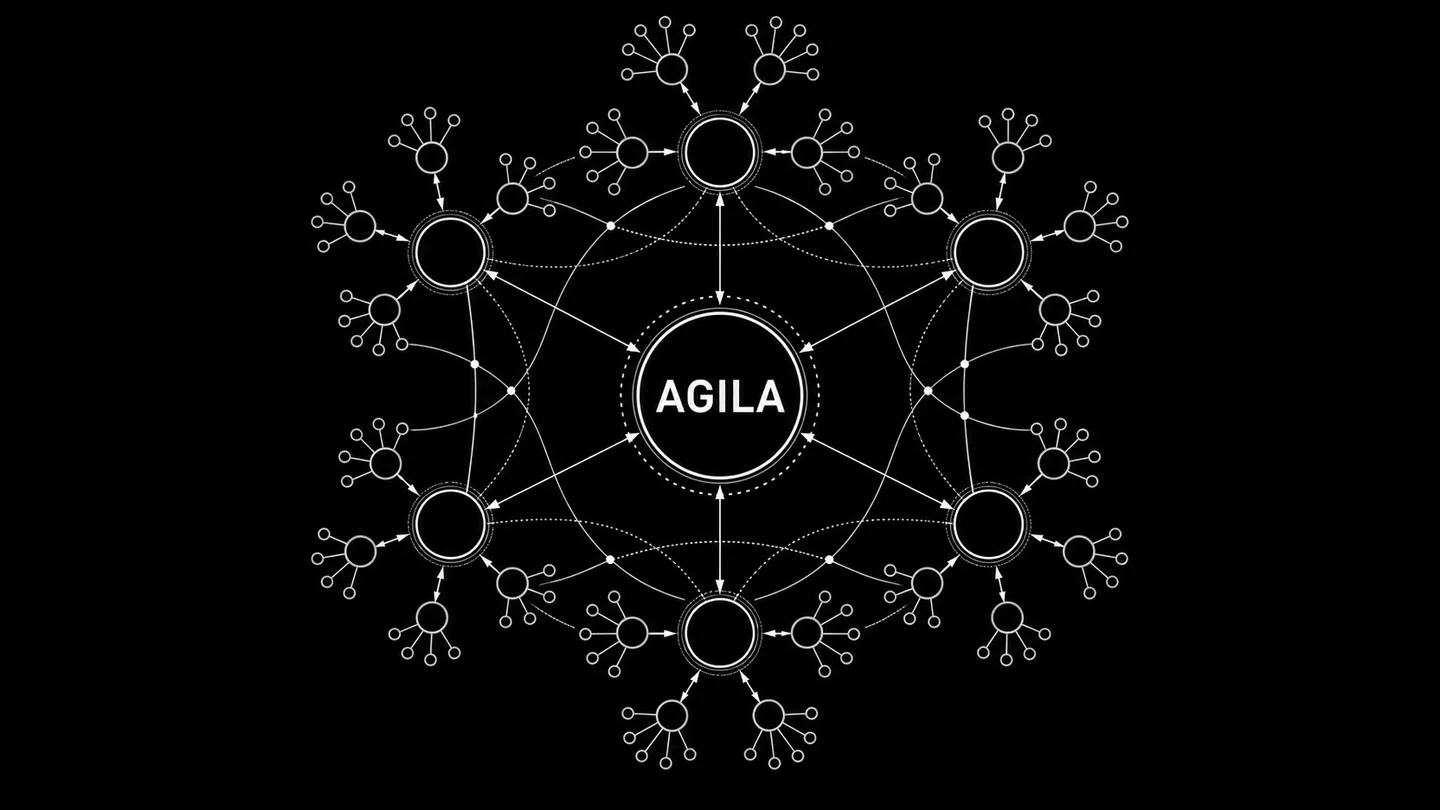
Capabilities / Interactive system

Capabilities that work as a system.

Agila connects six capability domains. Together, they help move a complex challenge from definition through design, delivery and adoption.

Choose a domain to see its capability areas and components. Follow the connections to understand what else the work may depend on.

6
Domains
24
Capability areas
100
Capability components

Interactive capability system

Choose a domain. Follow the connections.

Loading interactive map…Scroll to zoom · drag to pan · select a node
Browse the full list

Browse the complete capability list.

Open any domain to see its capability areas and components. Use the list to scan the whole system at your own pace.

01AI, data and analytics4 capability areas

Find where AI and analytics can improve real work, then put the right data, controls and operating foundations in place.

AI opportunity and readiness

  • Decision-first opportunity discovery
  • Process, people, data and architecture maturity
  • AI versus rules or conventional automation
  • Value, feasibility and risk portfolio

Data foundations, engineering and governance

  • Ownership and stewardship
  • Quality, profiling and exception handling
  • Canonical models, lineage and access
  • Source contracts, pipelines and operational handover

Analytics and decision systems

  • KPI trees and metric definitions
  • Executive and operational dashboards
  • Performance diagnostics and scenario analysis
  • Management cadence and decision follow-through

Governed agentic workflows and operating systems

  • Agentic architecture
  • Harness engineering
  • Graph engineering
  • Loop engineering
  • Context, memory and knowledge
  • Agents, skills, tools and applications
  • Evaluation, evidence and governance
  • Observability, resilience and recovery
02Business and operating-model transformation4 capability areas

Connect strategy to processes, roles, investment choices and adoption so that change works beyond the technology layer.

Discovery and current-state framing

  • Sponsor and decision-owner mapping
  • Pain and economic-consequence framing
  • Stakeholder, constraint and dependency mapping
  • Outcomes and acceptance criteria

Capability and process design

  • Capability and value-stream mapping
  • Current-state and target-state processes
  • Roles, handoffs and controls
  • Requirements and traceability

Value cases and roadmaps

  • Investment value, cost and total-cost framing
  • Scenario and sensitivity analysis
  • Value, feasibility and risk prioritisation
  • Roadmap and investment sequencing

Operating model and adoption

  • Decision rights and accountability
  • Organisation and service-delivery roles
  • Scorecards, cadence and management routines
  • Adoption and knowledge transfer
03Enterprise, solution and integration architecture4 capability areas

Define coherent current and target states, make technology trade-offs clear and give implementation teams designs they can use.

Enterprise and target-state architecture

  • Business, data, application and technology views
  • Current-state and target-state architecture
  • Principles, standards and architecture runway
  • Transition states and dependency roadmap

Solution architecture

  • Solution architecture descriptions
  • Functional and non-functional requirements
  • Decisions and trade-offs
  • Security, privacy, resilience and operability

Integration and interoperability

  • API and service-integration patterns
  • Event-driven architecture
  • Canonical models and data contracts
  • Source-to-target mapping and reconciliation

Platform assessment and design assurance

  • Architecture and technical maturity
  • Product and user-value maturity
  • Requirements-to-design traceability
  • Vendor and implementation assurance
04Industrial operations, IT/OT and IIoT4 capability areas

Connect plant, edge, cloud and enterprise environments with attention to operational context, resilience and scale.

Industrial operations and digital manufacturing

  • MES, SCADA, ERP and historian context
  • OEE, Andon and operator experience
  • Process-to-quality and parameter analytics
  • Multi-site digital-manufacturing roadmaps

IT/OT architecture and resilience

  • Segmentation, zones and conduits
  • Edge, plant, cloud and enterprise boundaries
  • Availability and failure domains
  • Monitoring, backup, recovery and rollback

UNS, MQTT and industrial connectivity

  • UNS principles, topic taxonomy and governance
  • MQTT and broker architecture
  • OPC UA and industrial-system integration
  • Payload semantics, quality and lineage

Operational-data and AI readiness

  • Operational-data landscape and quality
  • Context, units, timestamps and lineage
  • Anomaly, predictive and vision opportunities
  • Pilot feasibility and controlled scale-out
05Digital products and operating systems4 capability areas

Design and build purpose-built applications, dashboards, integrations and workflows that support a defined business need.

Product discovery and UX

  • User, job and workflow discovery
  • User journeys and interaction design
  • Functional scope and acceptance criteria
  • Privacy, multilingual and local-first choices

Applications and dashboards

  • Application and service development
  • Web and mobile interfaces
  • BI and operational dashboards
  • Workflow and conversational interfaces

APIs, connectors and automation

  • APIs, webhooks and service contracts
  • Workplace and collaboration integrations
  • CRM, document and business-system connectors
  • Messaging and workflow orchestration

Quality, deployment and handover

  • Unit, integration and regression testing
  • Release pipelines and deployment controls
  • Visual QA and accessibility review
  • Documentation, handover, support and rollback
06Governance, delivery and adoption4 capability areas

Keep programmes, AI use and implementation work accountable through clear ownership, evidence, assurance and knowledge transfer.

Programme and project delivery

  • Scope, work packages and delivery plans
  • Risks, assumptions, issues and dependencies
  • Stakeholder and governance cadence
  • Milestones, acceptance and transition

AI, data and privacy governance

  • Responsible-AI principles and risk taxonomy
  • Regulatory-workstream framing and specialist escalation
  • Data-use, privacy and security decisions
  • Vendor neutrality and governance controls

Human authority, evidence and assurance

  • Human decision rights and autonomy tiers
  • Maker-checker separation and approval gates
  • Provenance and public-claim controls
  • Tests, audit trails and recovery evidence

Training, adoption and knowledge transfer

  • AI literacy and tool selection
  • Architecture and industrial workshops
  • Playbooks, templates and knowledge assets
  • Train-the-trainer, reuse and improvement

This is a navigational capability model, not a fixed service catalogue, delivery promise or statement that every capability is used in every engagement.

Discuss a challenge

Where does your challenge enter the system?

Start with the decision, constraint or operating problem. The relevant capabilities can then be assembled around it.

Bring the challenge into focus